Suing a government agency in Pennsylvania is different from suing a private company. If a SEPTA bus struck you or someone you love while crossing Broad Street, stepping off a curb near 30th Street Station, or walking through Center City, you're facing a claim against one of the largest transit authorities in the country.
A SEPTA pedestrian accident claim in Philadelphia involves special rules that don't apply to ordinary car accident cases.
A Philadelphia pedestrian accident lawyer who handles claims against government entities can guide you through the process and protect your right to compensation.
Can You Sue SEPTA If You Were Hit by a Bus in Philadelphia?
- Yes. Pennsylvania law allows injured pedestrians to sue SEPTA despite its status as a government agency, but special rules apply.
- Sovereign immunity protects government agencies from most lawsuits, but Pennsylvania has exceptions that allow claims for vehicle accidents.
- You must provide written notice to SEPTA within six months of the accident, which is much shorter than the typical two-year deadline.
- Damages against SEPTA are capped at $500,000 per person under Pennsylvania law.
- Claims are filed in the Philadelphia Court of Common Pleas, not federal court.
SCHEDULE A FREE CONSULTATION TODAY
Where Do SEPTA Bus Pedestrian Accidents Happen in Philadelphia?
The Southeastern Pennsylvania Transportation Authority (SEPTA) operates more than 120 bus routes across the Philadelphia region. Buses travel through some of the city's busiest pedestrian corridors, creating countless opportunities for collisions.
When a SEPTA bus and pedestrian collision occurs, liability often depends on where the accident happened. High-risk areas include:
- Center City: Market Street, Chestnut Street, and Walnut Street see heavy bus traffic alongside thousands of pedestrians daily
- Broad Street corridor: From City Hall to Temple University and south to the stadiums, Broad Street buses share the road with constant foot traffic
- University City: Routes near Penn, Drexel, and the hospitals along Spruce and Walnut Streets create conflicts with students and medical staff
- Transit hubs: 30th Street Station, Suburban Station, and Jefferson Station generate heavy pedestrian activity where buses load and unload
- South Philadelphia: Busy commercial strips along Passyunk Avenue and near the Italian Market see regular bus service
Pedestrians also face risks near Philadelphia International Airport, where SEPTA Route 37 and the Airport Line connect travelers to public transit.
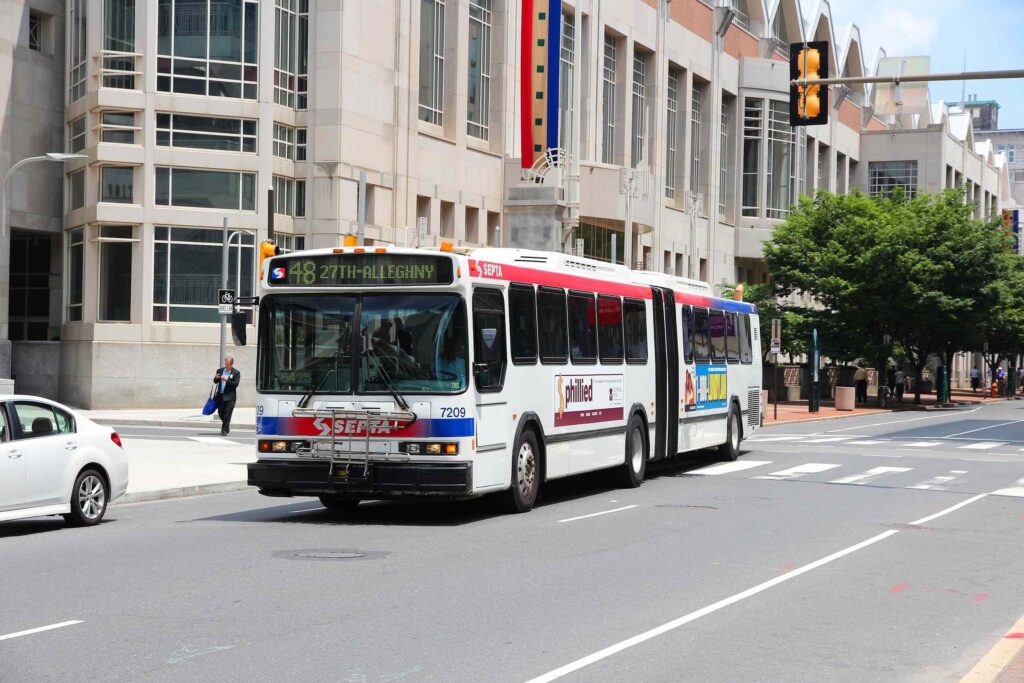
What Causes SEPTA Bus vs Pedestrian Collisions?
Bus drivers operate large vehicles with significant blind spots. When drivers fail to exercise proper care, pedestrians pay the price. Common causes include:
Failure to Yield at Crosswalks
Pennsylvania law requires drivers to yield to pedestrians in crosswalks. Bus drivers who run red lights, roll through stop signs, or fail to wait for pedestrians to clear the intersection can be held liable.
Blind Spot Accidents
SEPTA buses have large blind spots, especially on the right side and directly in front of the vehicle. Drivers must use mirrors and check blind spots before turning or pulling away from stops.
Distracted Driving
Bus drivers who look at phones, adjust equipment, or become distracted by passengers may not see pedestrians in time to stop.
Speeding and Aggressive Driving
Pressure to stay on schedule can lead drivers to speed or take risks. A bus traveling too fast cannot stop quickly enough to avoid hitting a pedestrian who steps into the road.
How Does Pennsylvania Sovereign Immunity Affect SEPTA Lawsuits?
Government agencies normally enjoy protection from lawsuits under a legal doctrine called sovereign immunity. However, sovereign immunity exceptions in Pennsylvania allow injured individuals to sue government entities under certain circumstances.
The Pennsylvania Sovereign Immunity Act (42 Pa.C.S. § 8522) lists eight categories where the government waives immunity. Vehicle liability is one of them. This exception allows pedestrians to sue SEPTA when a bus causes injury.
The law also caps damages at $500,000 per person and $1 million per accident. Unlike private lawsuits, where a jury could award millions for catastrophic injuries, claims against SEPTA face these statutory limits.
What Are the Notice Requirements After a SEPTA Accident?
Filing a pedestrian injury claim against a government entity in PA requires strict compliance with notice deadlines. For SEPTA claims, you must provide written notice within six months of the accident.
The notice requirements after a SEPTA accident include specific information:
- Your name and address
- The date, time, and location of the accident
- A description of how the injury occurred
- The nature and extent of your injuries
- The name of the government entity (SEPTA)
Missing the six-month deadline can bar your claim entirely, regardless of how serious your injuries are. This is considerably shorter than the standard two-year statute of limitations for personal injury cases in Pennsylvania, making quick legal action especially urgent.
How Do You Prove a SEPTA Bus Driver Was Negligent?
Proving negligence requires showing that the bus driver failed to exercise reasonable care and that failure caused your injuries. Key evidence includes:
- Bus camera footage: SEPTA buses have interior and exterior cameras that may capture the collision.
- GPS and speed data: SEPTA tracks bus locations and speeds, which can show if the driver was speeding or made sudden movements.
- Traffic camera footage: City cameras at major intersections throughout Philadelphia may have recorded the accident.
- Witness statements: Other pedestrians, passengers on the bus, and nearby drivers can describe what they saw.
- Driver records: The driver's employment history, training records, and any prior incidents may be relevant.
- Accident reconstruction: Engineers can analyze the scene, vehicle damage, and injuries to determine how the collision happened.
An attorney can subpoena this evidence from SEPTA before it's destroyed or lost. Acting quickly helps preserve critical records.
What Compensation Can You Recover in a SEPTA Pedestrian Accident Claim?
Pedestrians struck by buses often suffer catastrophic injuries. The impact between a 40,000-pound bus and a person on foot can cause traumatic brain injuries, spinal cord damage, multiple fractures, and internal organ damage. Some accidents are fatal.
Recoverable damages include:
- Medical expenses: Emergency care at Jefferson Hospital, Penn Medicine, Temple University Hospital, or other facilities, plus ongoing treatment and rehabilitation
- Lost wages: Income lost while recovering and future earning capacity if you cannot return to work
- Pain and suffering: Compensation for physical pain and emotional distress
- Disability and disfigurement: Long-term or permanent effects of your injuries
- Wrongful death: If a loved one died, family members may recover funeral expenses, loss of support, and loss of companionship
Remember that Pennsylvania's damage cap limits recovery to $500,000 per person against SEPTA. An attorney can advise whether other parties may share liability and whether additional recovery is possible.
How Do You File a SEPTA Pedestrian Accident Claim in Philadelphia?
Claims against SEPTA follow a specific process. To position yourself for a successful recovery, contact an experienced Philadelphia personal injury lawyer who is familiar with the special requirements involved in taking legal action against government entities.
The steps your lawyer takes will generally follow this process:
- Provide written notice: Within six months, send a formal notice to SEPTA's legal department identifying the accident and your injuries
- Gather evidence: Your lawyer collects medical records, photos, witness information, and requests bus camera footage before it's overwritten.
- File a lawsuit: If SEPTA denies your claim or offers inadequate compensation, your attorney can file suit in the Philadelphia Court of Common Pleas.
- Discovery and negotiation: Your lawyer exchanges evidence with SEPTA's attorneys and attempts to negotiate a settlement
- Trial: If settlement talks fail, your case may go to trial, where your attorney presents your case to a judge or jury.
Most SEPTA claims settle before trial, but having an attorney prepared to go to court strengthens your negotiating position from the beginning.
What If the Pedestrian Was Partly at Fault?
Pennsylvania follows modified comparative negligence rules. You can recover damages as long as you were less than 51% responsible for the accident. Your compensation is reduced by your percentage of fault.
SEPTA's attorneys often argue that pedestrians contributed to their own injuries by jaywalking, crossing against signals, or not paying attention. An attorney can counter these arguments by showing the bus driver had time to react, should have seen the pedestrian, or was violating traffic laws.

For example, if you stepped into a crosswalk while the walk signal was illuminated and the bus turned into you, the driver is likely at fault regardless of any claim that you should have waited. Similarly, if you were hit while standing on the sidewalk or at a bus stop, SEPTA cannot reasonably argue you contributed to the accident.
What Should You Do After Being Hit by a SEPTA Bus?
If you’re already receiving medical care for injuries from a SEPTA bus collision, you’ve taken the most important first step. While you focus on healing, there are other steps that can protect your legal claim:
- Hire a lawyer: The six-month notice deadline for SEPTA claims is strict. An attorney can handle the legal requirements, request evidence before it disappears, and deal with SEPTA’s adjusters so you can concentrate on getting better.
- Keep all medical appointments: Follow through with every treatment your doctors recommend. SEPTA’s lawyers will look for gaps in your medical care and argue that your injuries aren’t as serious as you claim.
- Journal your recovery: Write or record video entries about your pain levels, what activities you can’t do, and how your injuries affect daily life. This creates a real-time record that shows the true impact of your injuries.
- Preserve any evidence you have: If you took photos at the scene, noted the bus number, or got witness contact information, keep it safe. Share it with your attorney.
- Don’t give recorded statements to SEPTA: Insurance adjusters may call asking for your version of events. Anything you say can be used to reduce or deny your claim. Let your attorney handle communications.
Your job right now is to heal. A lawyer can handle the rest.
FAQs About SEPTA Pedestrian Accident Claims in Philadelphia
How long do I have to file a claim against SEPTA?
You must provide written notice to SEPTA within six months of the accident. After that, you have two years from the accident date to file a lawsuit. Missing the six-month notice deadline can bar your claim entirely.
Is there a limit on how much I can recover from SEPTA?
Yes. Pennsylvania law caps damages at $500,000 per person and $1 million per accident for claims against government entities like SEPTA. This cap applies regardless of how severe your injuries are.
Can I sue the bus driver personally?
Generally no. SEPTA employees acting within the scope of their employment are protected by the same sovereign immunity rules as the agency. Your claim is against SEPTA, not the individual driver.
What if my loved one died after being hit by a SEPTA bus?
No amount of compensation can ease the pain of losing someone to a preventable accident, but a fair settlement can ease the burden of financial strain during an already difficult time. Pennsylvania families may pursue wrongful death claims to recover funeral costs, lost financial support, and the profound emotional suffering. The same six-month notice requirement applies, so reach out to an attorney as soon as you can.
What if I was hit near a SEPTA bus stop, not by the bus itself?
If a bus driver's negligence caused your injury, such as pulling away without checking for pedestrians, SEPTA may still be liable. Other scenarios might involve claims against the City of Philadelphia or private property owners, depending on where and how the accident occurred.
How much does it cost to hire Hill & Associates for a SEPTA accident case?
Hill & Associates handles SEPTA pedestrian accident cases on a contingency fee basis. You pay nothing up front, and we only get paid if we recover compensation for you. Your initial consultation is free and confidential.
Struck by a SEPTA Bus? Get Help With Your Claim Today.
Being hit by a bus while walking through Philadelphia can leave you with serious injuries and mounting bills. Whether you were struck crossing Market Street in Center City, waiting at a stop in South Philly, or walking near the hospitals in University City, the impact of a SEPTA bus collision can be devastating.
If a SEPTA bus injured you or someone you love, speak with a Philadelphia pedestrian accident lawyer at Hill & Associates today. The six-month notice deadline applies to these claims, so getting legal help quickly can protect your right to compensation.